01
Intake
Import findings from AI hunters, scanners, red teams, PSIRT queues, bug bounty reports, or external assessments while preserving source, scope, owner, assets, and raw evidence.
365UI — Private AI Systems for High-Stakes Workflows
Superagent and OrgMem power private enterprise knowledge workflows, while BMC Red-Team Lab and Ironclad apply the same traceability, approvals, evidence, and audit discipline to AI-infrastructure security.
Powered by reusable platforms. Delivered by forward-deployed engineers inside the customer’s real environment.

Finding-to-Fix Workflow
365UI receives findings from AI tools, scanners, red teams, PSIRT, and external assessments, then drives evidence validation, approval gates, engineering handoff, fix regression, and defensive pairing.
01
Import findings from AI hunters, scanners, red teams, PSIRT queues, bug bounty reports, or external assessments while preserving source, scope, owner, assets, and raw evidence.
02
Deduplicate, classify, and grade trigger path, impact, disclosure route, priority, and next experiment so noise does not become a metric.
03
Run RE queries, reachability checks, reproduction conditions, false-positive checks, and lab attestation. Risky actions stay behind approval gates.
04
Create engineering-readable evidence packs, fix briefs, risk notes, test commands, and code-owner handoff materials.
05
Run reattack gates, regressions, merge-ready checklists, and post-fix proof that the original path is blocked.
06
Pair Sigma / SIEM notes, negative corpus, cleanup verification, and audit trail so remediation and defense close together.
Customer Deliverables
Every deliverable maps to an engineering action and acceptance criterion: who owns it, how it reproduces, what proves the fix, how defenders detect it, who approved it, and where evidence lives.
Reproduction conditions, trigger path, blast radius, evidence files, confidence, gaps, and next experiment.
Minimal fix suggestion, test command, risk note, and regression condition the code owner can act on.
Allowed / restricted / prohibited action matrix that keeps AI tools inside approved customer boundaries.
Reattack gate plus regression proving the original path is blocked without weakening safety gates.
Sigma / YARA / IOC / query rule drafts with benign false-positive validation.
Who approved what, what ran, where evidence lives, and how status changed for PSIRT and compliance.
Platform
Superagent, OrgMem, BMC Red-Team Lab, and Ironclad provide the reusable product core. Forward-deployed engineers connect that core to each customer’s data, infrastructure, controls, and acceptance criteria.
Reusable module
Superagent combines private retrieval, agent orchestration, document processing, and replaceable infrastructure into a reusable runtime.
Reusable module
OrgMem preserves traceable organizational experience through versioned knowledge, reviewed writes, and tiered agent memory.
Reusable module
BMC Red-Team Lab productizes controlled validation, reproducible evidence, engineering handoff, and remediation paths.
Reusable module
Ironclad constrains infrastructure actions with read-first workflows, risk gates, confirmations, and audit evidence; it is currently a PoC.
Reusable module
Deployment and hardening modules around third-party agent runtimes cover onboarding, observability, backup, and sandbox controls.
Reusable module
Deterministic fixtures, replay, approval gates, audit records, and engineering handoff keep systems within measurable acceptance boundaries.
Proof of Work
Starting with the product core, delivery maps to real business and engineering actions: grounded retrieval, governed tool use, approvals, evidence, handoff, and audit.
Read full case studiesCurated capability proof
A bilingual live-interpretation workflow uses operator controls, failure handling, deterministic fixtures, and evidence-backed acceptance gates; it does not claim event deployment, accuracy, or latency.
Book 365UI Live InterpretationCurated capability proof
Multi-user deployment and hardening around third-party agent runtimes cover onboarding, observability, backup, and sandbox controls; no base-runtime ownership, production deployment, or completed-roadmap claim is made.
Curated capability proof
Service integration, tests, and operational optimization around upstream models support reusable retrieval, embedding, and reranking workflows; no proprietary-model or unpublished performance claim is made.
Superagent Deep Dive
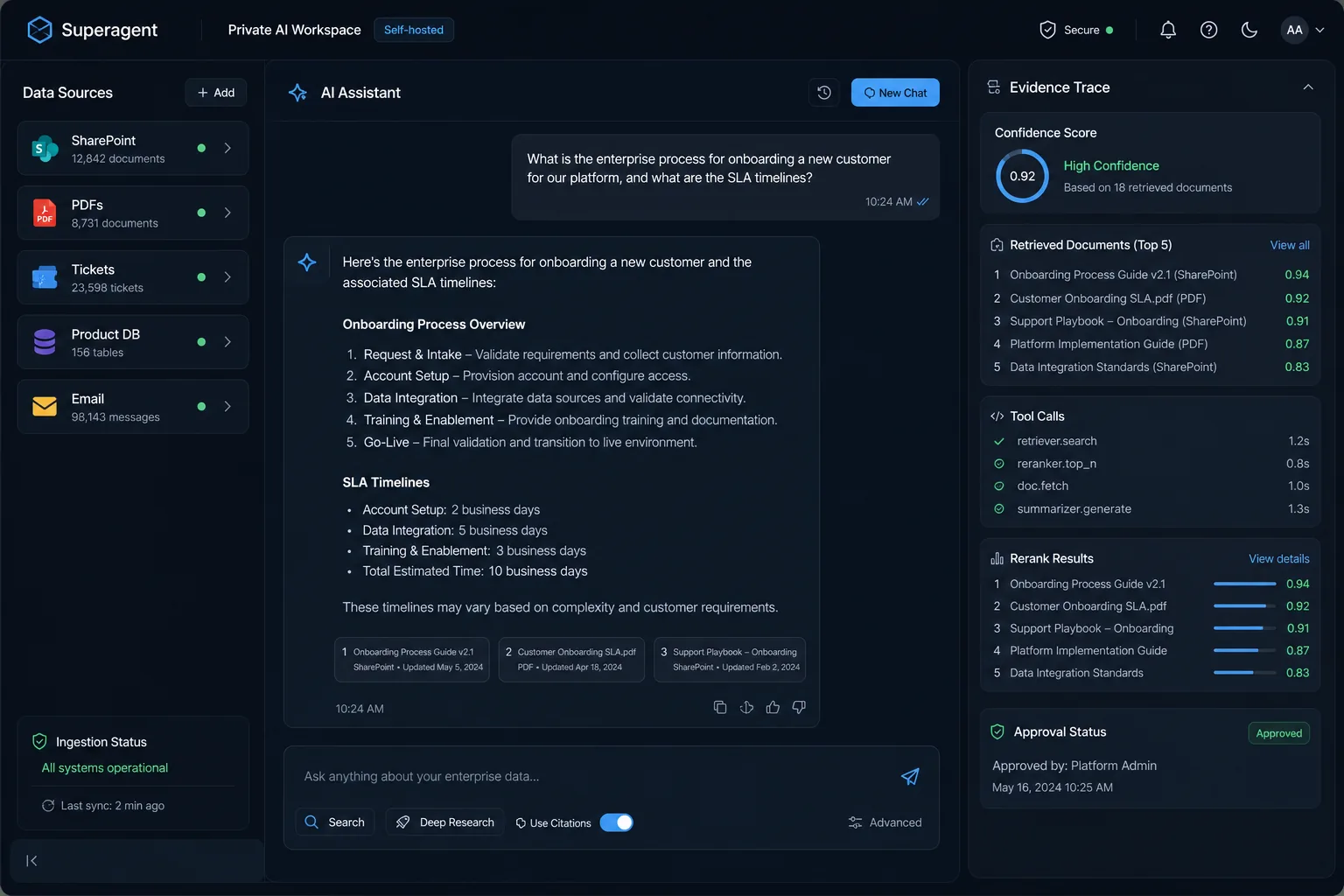
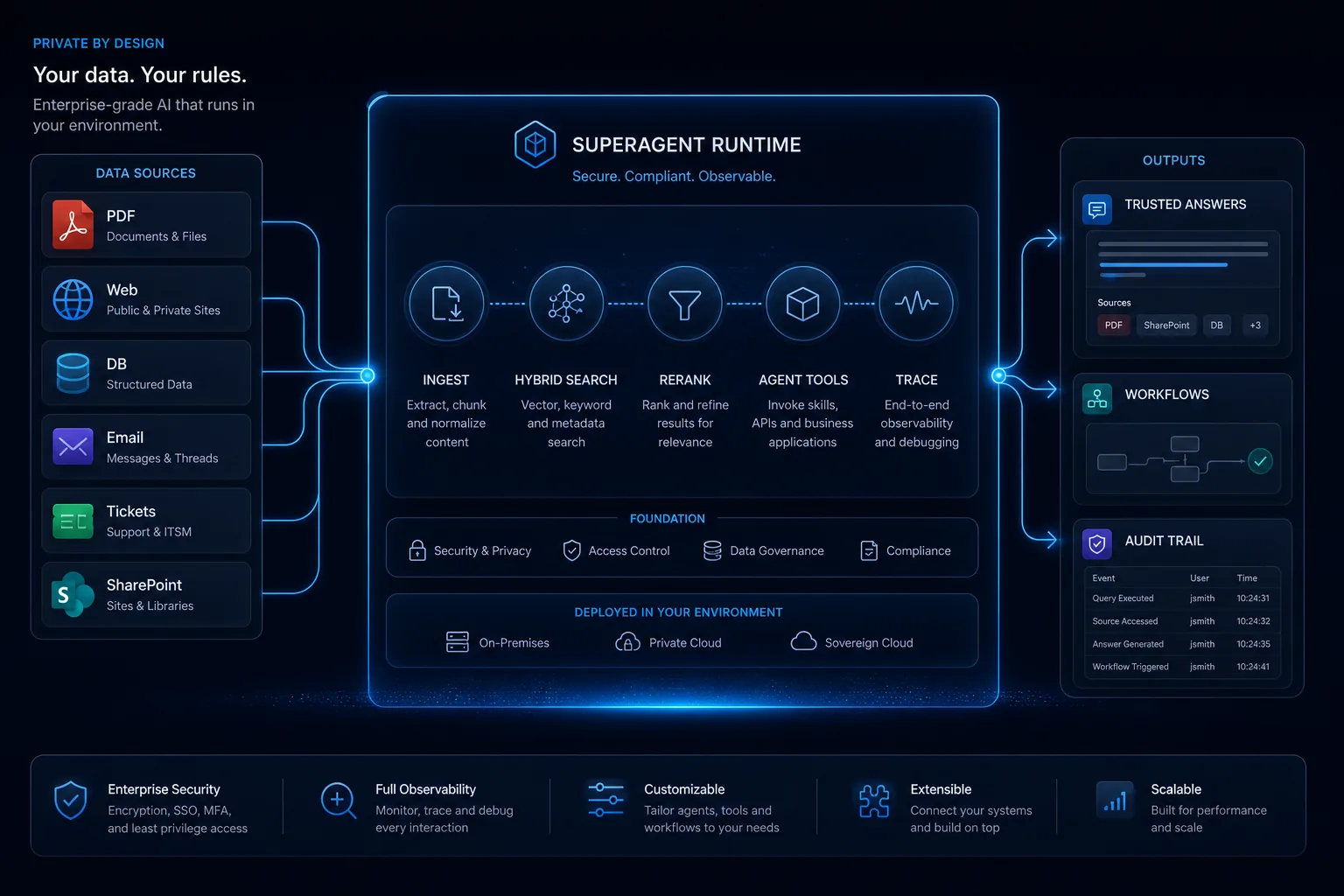
Superagent turns fragmented enterprise knowledge into reliable private RAG and agent workflows. It is purpose-built for scenarios where answers require multiple evidence sources: documents, web pages, product catalogs, tickets, structured databases, and operational data.
The core advantage is full control. A FastAPI / LangGraph runtime connects hybrid vector + keyword retrieval, Qwen3 embedding / reranking, document parsing, evaluation, and observability; models, vector stores, search engines, and connectors remain replaceable and tunable.
Request path

Crawl websites, parse PDFs and Office files, normalize HTML tables, enrich chunks with context, and keep indexes fresh as source data changes.
Combine semantic vector search, keyword search, RRF fusion, reranking, metadata filters, and parent/sibling expansion so answers come from the right evidence.
Expose RAG and tool-using agents through an OpenAI-compatible API, with task-specific models, structured tool calls, and a single chat/completions entry point.
Inject live product, inventory, ticket, CRM, SQL, or operational data into the answer path instead of relying only on static documents.
Trace every retrieval and generation step, compare answer quality, inspect failed recalls, and improve chunking, ranking, prompts, and tools over time.
Run inside a customer-controlled environment with replaceable models, vector stores, search engines, and data connectors.
OrgMem Deep Dive
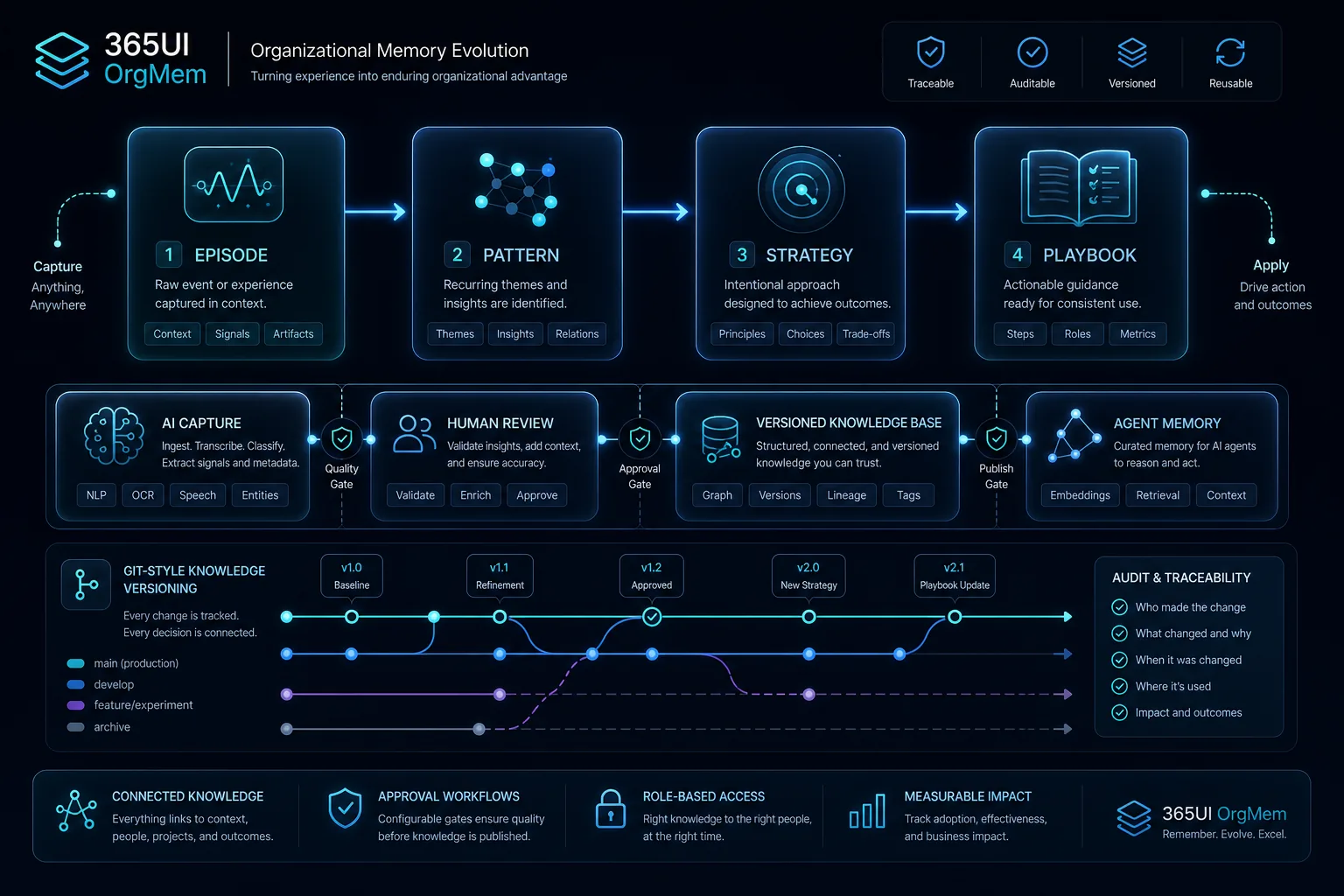
OrgMem puts organizational knowledge, decision history, and agent execution memory into one auditable system. It is both a knowledge base and a long-term memory layer: humans keep governance, while agents gain structured read/write access and continuous learning.
Memory evolution path
Episode → Pattern → Strategy → Playbook
Failures are remembered, successes are reinforced, and repeatedly verified experience becomes durable organizational know-how.

Knowledge lives in Markdown + Git — not locked into a proprietary database or SaaS. Every change is tracked, auditable, and supports branching and review.
AI continuously captures and distills execution insights, but formal organizational knowledge requires human review before entering the knowledge base — ensuring accuracy and trust.
Semantic retrieval and exact keyword matching work together with multi-stage reranking and entity boosting — balancing conceptual understanding with terminology precision for real enterprise knowledge.
More than document search. OrgMem records execution traces, failure analyses, effective strategies, and team preferences so AI assistants continuously learn from experience.
Current-task knowledge is instant, project-level strategies preload at session start, and cross-project knowledge is retrieved on demand — minimizing noise and maximizing relevance.
Confidence scores, usage frequency, and recency govern knowledge validity. Repeatedly verified high-value patterns are automatically promoted into formal playbooks.
BMC Red-Team Lab · Latest
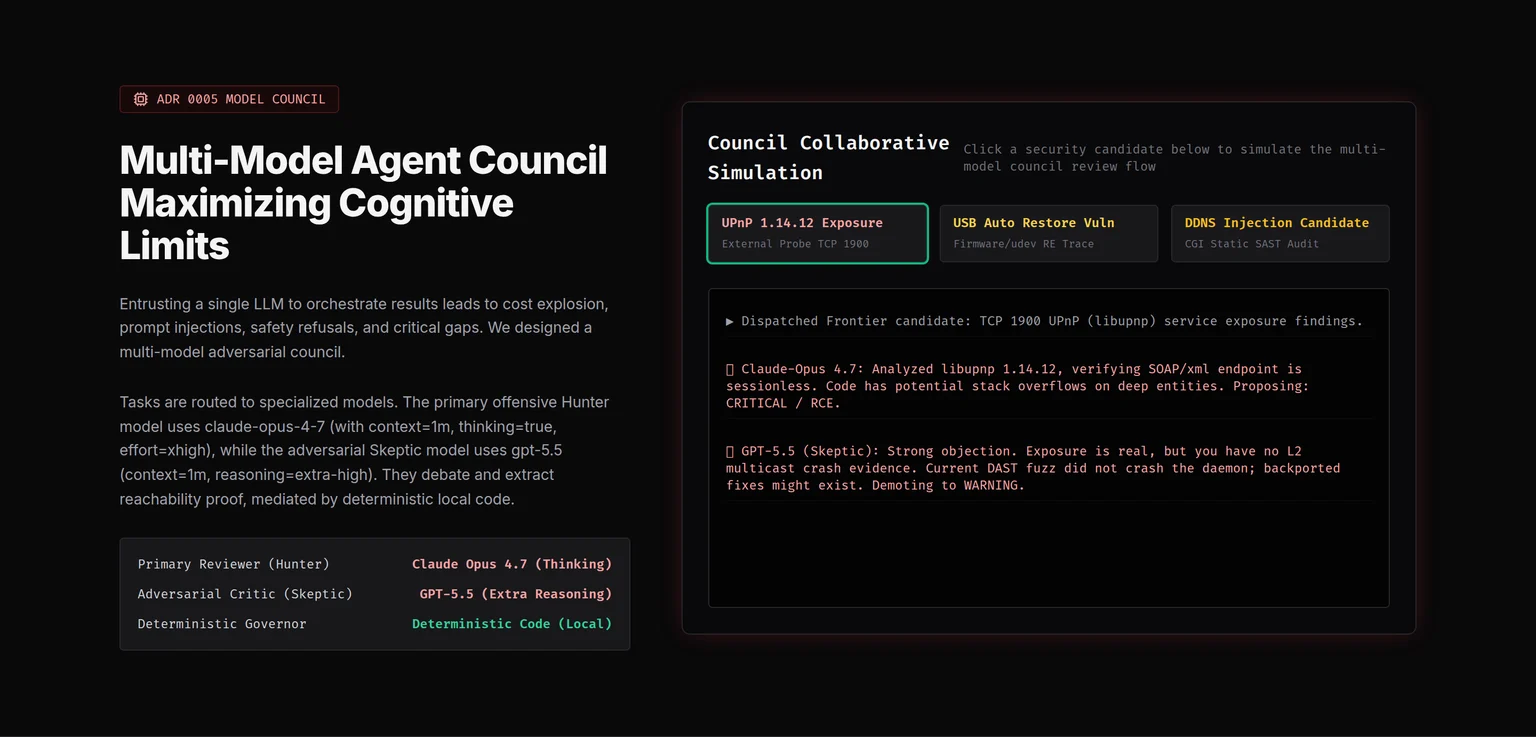
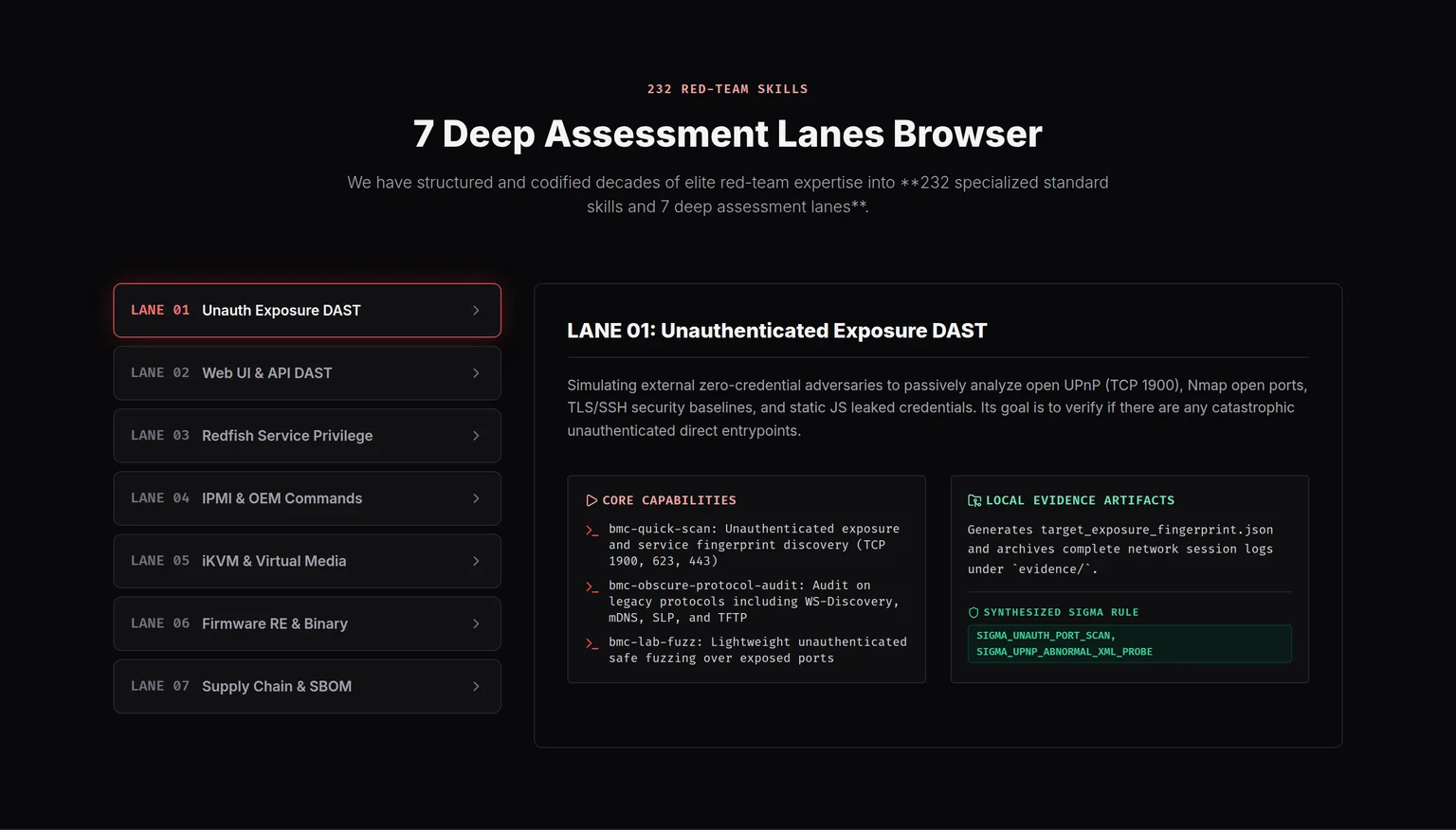
268 specialized skills route across 7 assessment lanes and 10 vendor / family packs — Unauth-DAST, Web UI, Redfish privilege mapping, IPMI / OEM, iKVM, firmware RE, supply-chain SBOM, OpenBMC / libpldm collaboration, and QEMU emulated validation. A multi-model Council pits Hunter (Claude Opus 4.8) against Skeptic (GPT-5.5) on every candidate, with a deterministic Governor making the Fail-Closed final call.
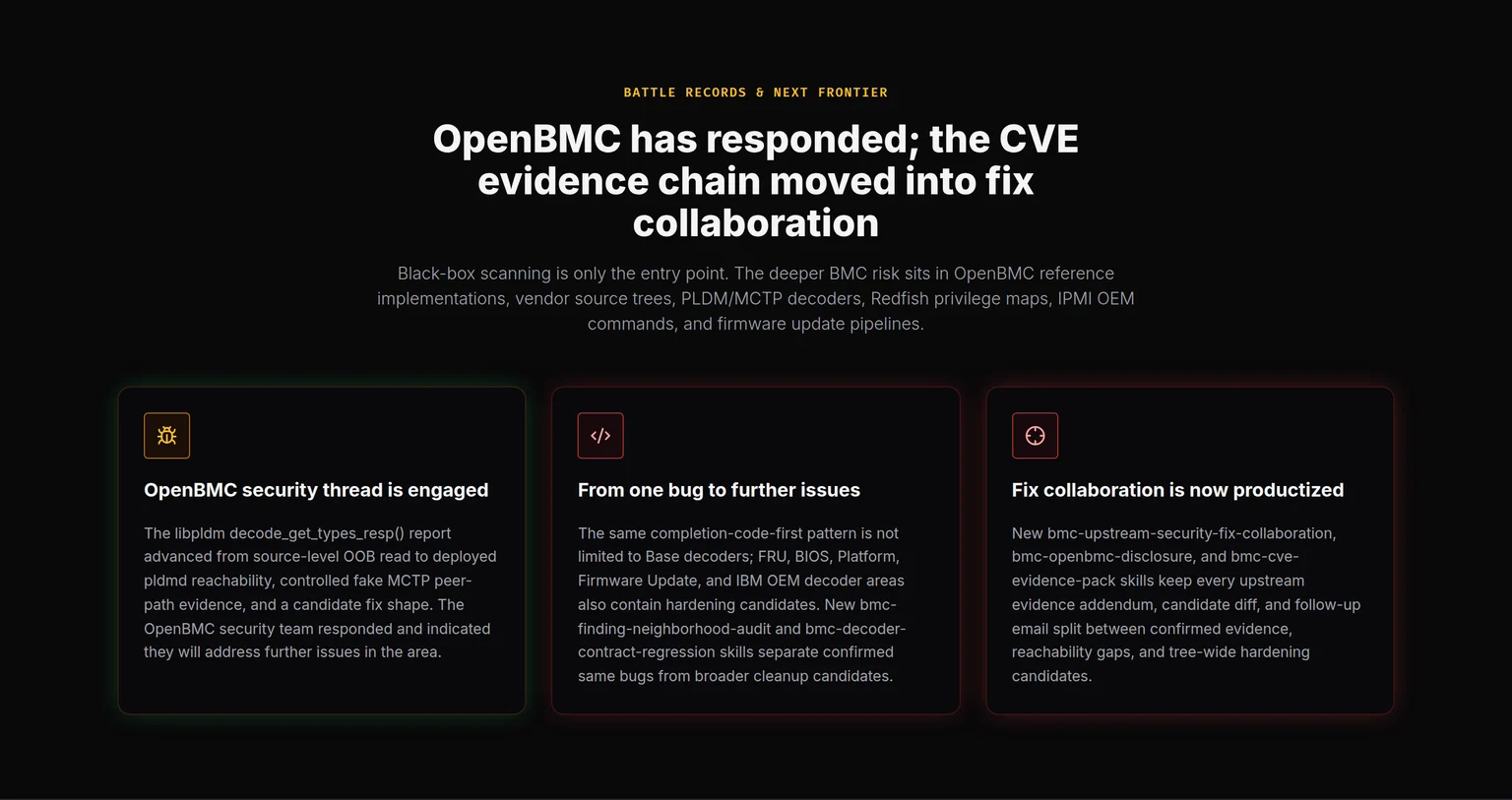
Every finding climbs a Proof Ladder and evidence-priority model — static candidate → deployed daemon reachability → QEMU full-system / lab_validation_emulated → approval-lease-gated real-hardware validation — and every offensive primitive ships with a paired Sigma detection rule. The latest pass adds BMC-TLO multi-step emulation benchmarks, automatic chain construction, fleet-scale dedupe and throughput SLOs, field journals, tool-index preflight, and redaction / poisoning scans. The OpenBMC libpldm decode_get_types_resp() report is in upstream fix collaboration.


Product-powered forward deployment
01
Define one workflow, environment, owner, data boundary, and success metric.
02
Use a fixed scope, fixed acceptance criteria, and reusable platform components to validate the system.
03
Connect customer-controlled infrastructure, integrations, approvals, migration, and engineering handoff.
04
Continue evaluation, governance, observability, upgrades, and workflow expansion.
Customer-specific integrations stay isolated; reusable engineering patterns, tests, and controls improve the platform without sharing customer data.
FAQ
Scanners and pentests produce findings. 365UI turns findings into work engineering can consume, leadership can track, and defenders can detect.
Yes. AI hunters, scanners, red-team reports, PSIRT cases, bug bounty reports, and external assessments can all enter the same evidence validation and engineering fix workflow.
BMC / firmware is high-risk, difficult, and technical enough to prove 365UI can handle real evidence, approvals, engineering handoff, and paired defense. Once hardened there, the workflow can move into OT, kernel drivers, cloud control planes, and AI agent operations.
AI security discovery tools will create more suspected issues. The missing layer is a private, controlled, auditable finding-to-fix pipeline.
Superagent + OrgMem serve enterprise private AI, retrieval, agents, and organizational memory. BMC Red-Team Lab + Ironclad serve AI-infrastructure security and finding-to-fix evidence workflows. They are equal pillars that share the same discipline for traceability, approvals, evidence, and audit.
OrgMem stores more than documents. It captures decision history, execution lessons, failure analysis, effective strategies, and agent memory, then promotes verified experience into official organizational knowledge through human review and versioning.
Yes — BMC Red-Team Lab is the proof. 268 specialized skills route across 7 assessment lanes and 10 vendor / family packs, with a multi-model Council debating every candidate (Hunter = Claude Opus 4.8, Skeptic = GPT-5.5, Governor = deterministic Fail-Closed code). Findings move through a Proof Ladder and evidence-priority model from static candidate to daemon reachability, QEMU full-system / lab_validation_emulated, then approval-lease-gated real-hardware validation. The system now includes BMC-TLO multi-step benchmarks, fleet-scale dedupe/SLOs, field journals, tool-index preflight, and paired Sigma defenses. The OpenBMC libpldm report is acknowledged upstream by the OpenBMC security team.
Bring one enterprise knowledge workflow or security finding source, a clear scope, and a business owner. We start with a verifiable private AI pilot or evidence pack, then scale into a long-running control plane.